Why it matters
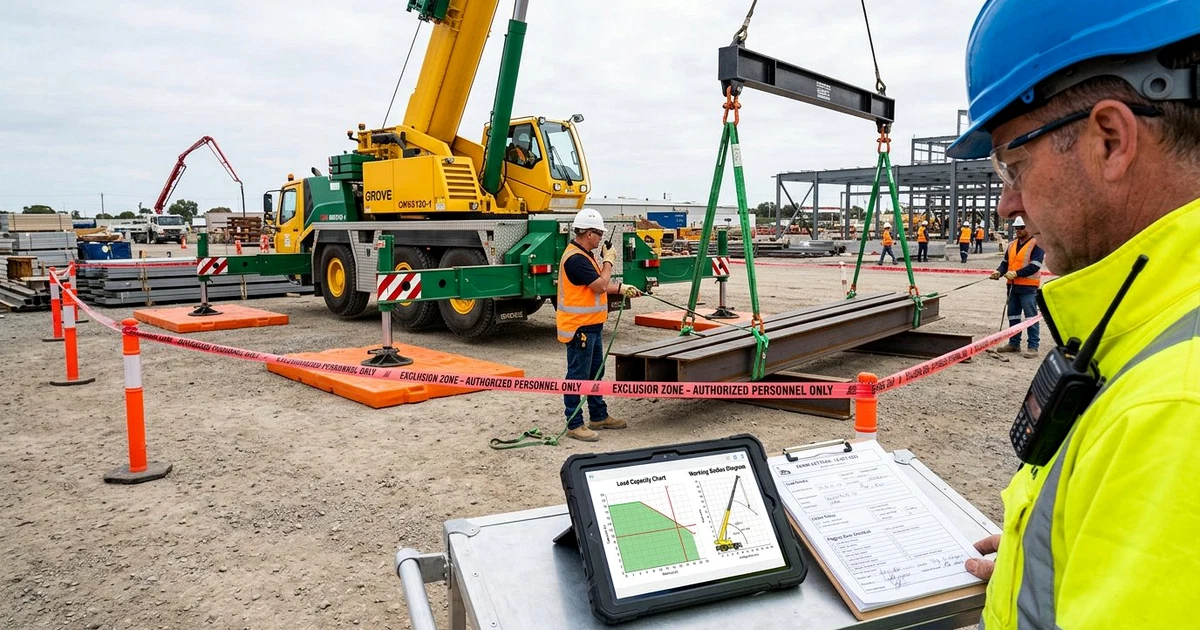
A robust lifting plan considers ground conditions, radius, load weight, accessories, team roles and contingency arrangements, not just crane capacity. The subject should therefore be managed as an HSE process that combines planning, field verification, competence and management follow-up, rather than as a stand-alone checklist.
The first step is to define where and under what conditions the task will be performed. Risks such as incorrect load weight or centre of gravity and insufficient ground bearing capacity should be discussed before work starts and the controls should be physically verified. If the control described in the document is not present in the field, the work should not start.
Critical risks
- Incorrect load weight or centre of gravity
- Insufficient ground bearing capacity
- Incorrect radius or capacity assessment
- Unclear team roles
Field controls
- ✓Verify load information from a technical source
- ✓Plan outrigger support and ground conditions
- ✓Check WLL ratings of lifting accessories
- ✓Conduct a pre-lift team briefing
Practical approach
The second step is execution quality. Controls such as verify load information from a technical source and plan outrigger support and ground conditions become auditable when ownership and verification timing are clear. Safety is not owned only by the HSE team; planners, supervisors and the workforce are part of the same control system.
The third step is managing change. If the crew, work area, method or simultaneous activity changes, the plan must be challenged again. New exposure such as incorrect radius or capacity assessment or unclear team roles may require a revised JSA, PTW or field plan.
Verify that the control actually works in the field before work starts rather than relying on paperwork alone.
Common mistakes
A common failure is equating the existence of a procedure with an effective control. Another is assigning ownership only to HSE. A third is continuing after conditions change without reassessing the risk.
Finally, closure quality must be verified. Closing a finding is more than attaching a photograph: the team should understand why the control was lost, what changed to prevent recurrence and whether the corrective action is effective. That is how routine field control becomes part of a management system.
Five management questions
- What is the worst credible consequence?
- Which critical barrier prevents that outcome?
- Who verifies that the barrier works, and when?
- Who can stop the work if conditions change?
- If the issue repeats, which system decision will we change?